Saturday, May 7, 2022

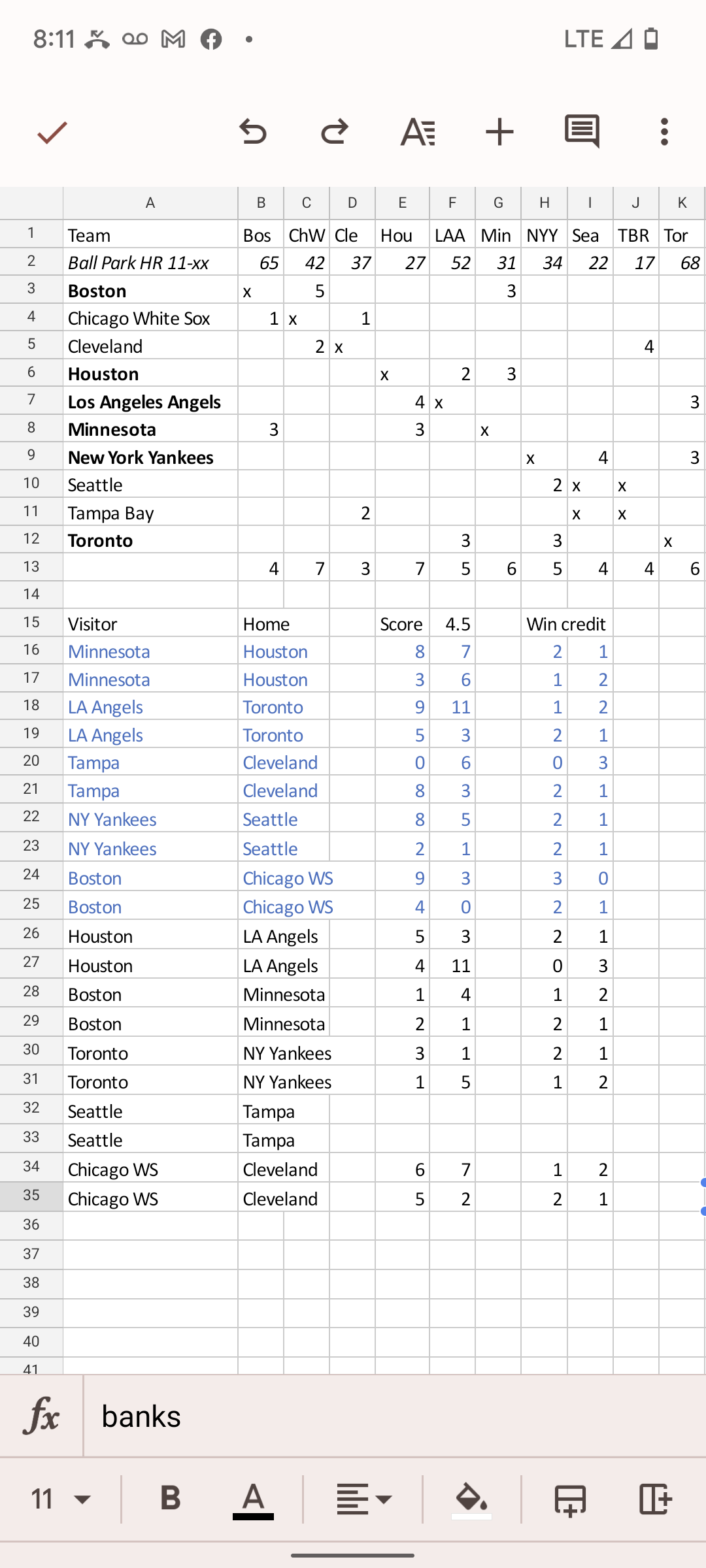
Bieber ERA 0.00 thru 2 gms, but pen blows 5-run sweep

Bieber went 7 innings allowing only one unearned run to keep a 0.00 ERA after two starts, but the bullpen could not hold his 6-1 lead to give him a second straight sweep.

If the Angels had not scored 2 runs in the bottom of the 8th after he left then Bieber would have 2 of only 5 SWEEPS (5 run lead after 8 up) in the first 26 games of year - as it is only the Yanks Cole and Red Sox Eovaldi have matched Bieber in gems for sweeps, and the Angels slugged their way to an 11-4 sweep.

Typically in 26 games one team or the other would have SWEPT 7 games - so 4 is behind pace. This is just a league rule we play in our seasons, but certainly not required to play Statis-Pro Baseball.

The Indians 11-7 record is much better than their actual MLB record, but we use 4-man rotations so any great pitchers like Bieber make a team batter in our game then when he is only pitching ever 5 or 6 games in MLB.

Here is the score sheet of the doubleheader and then the standings and game log.


Thursday, May 5, 2022

ChiSox Twins, 3-game sweeps, baserunning

 A couple of Statis-Pro items came up in the ChiSox vs. Twins series.

First, I traveled and forgot my board chart on runners taking an extra base hits. I looked it up and am pasting the image below for any time a runner wants to take and extra base on a hit, which several tried during the two games.

All 2022 Projected Batters (49 pages, 9 cards to a page) and All 2022 Projected Pitchers (62 pages, 9 cards to a page) is the only other thing needed to play the game, though more detailed instructions appear in this Statis-Pro baseball Game Rules.


While the inventors originals ranges were pretty neat you need to make two adjustments to be accurate.

First, rather than ADDING 20 to the ranges with two outs, you should actually use these ranges with two outs and SUBTRACT 20 of there are less than two outs.

The other change to be accurate is that the runner is rarely OUT trying to advance, if he does not advance it usually means the runner held to the same number of bases as the batter.

The runner should only be thrown out if:

87-88 if outfielder is a T2

85-88 if T3

83-88 if T4

81-88 if T5

This matches the actual modern percentage is 30% takes the extra base, 68% goes only as many bases as batter, and less than 2% thrown out.

The second factor is just a little quirk we play - that every game counts as a 2-1 series win, or a sweep only if the winning team led by at least 5 at the end of 8 innings without their available reliever with the nest ERA used through 8 innings. Teams only do this 14% of the time, same as the chance of sweeping a 3-game series.

With the White Sox awesome lineup but terrible pitching and fielding cards, they may have the best chance of either being swept or sweeping the opponent.

The ChiSox we're in the verge with a 10-5 lead going in the bottom of the 7th but Correa and Polanco singled and if the ChiSox used their PB 2-9 closer Hendriks they would have voided the chance for a 3-game sweep, so Kopech stayed in and Sano hit a 3-run homer. Hendrik saved the wild 10-8 win in the 9th.

The second game it was the Twins on the verge of a sweep with a 4-0 lead in the bottom of the 8th with bases loaded and one out. In that caee the White Sox could use their best remaining reliever (with Hendriks having pitched the first game, Graveman was the best ERA) and he got out of it, though Buxton drove a DEEP drive but it was a"52," and homers occur only on a 11-31 on games in Minnesota. The twins held on for a 4-0 win, so no sweep for either team and the series is a 3-3 split.

As you can see from the game log below the score sheet, only 4 of 24 games.so far have been a sweep in our league play so far.


Tuesday, May 3, 2022

Yankees move into 1st with late surge vs Red Sox

 Finally got in the first game of May, back at my place with my 1978 fast action cards and board but 2022 projected cards.

All 2022 Projected Batters (49 pages, 9 cards to a page) and All 2022 Projected Pitchers (62 pages, 9 cards to a page) is the only other thing needed to play the game, though more detailed instructions appear in this Statis-Pro baseball Game Rules.

The Yankees moved into first place by virtue of a Cole vs Eovoldi scoreless tie in the bottom of the 6th exploding into a 10-7 Yankees win 


Saturday, April 30, 2022

Using Statis-Pro Cards to Pick MLB Line-ups and Rotations.

This blog gives an easy step-by-step to look at a new team for the first time and pick the starting rotation, bullpen order and batting order. 

All 2022 Projected Batters (49 pages, 9 cards to a page) and All 2022 Projected Pitchers (62 pages, 9 cards to a page) is the only other thing needed to play the game, though more detailed instructions appear in this Statis-Pro baseball Game Rules.

Because we were not that familiar with the personnel for the young Seattle Mariners, we use them as an example below, and once showing you how we picked our line-ups and rotation, culminate by showing you the very exciting game they played at Tampa to wrap up our 2nd round of AL play. Through those games, teams are average 4.4 runs per game, and yet the finale included both teams getting 4 runs on one play with Grand Slam homers.

Step 1 - Choosing the Starter at all 8 positions and DH

Once we print and cut out the team's Statis-Pro player cards we take the batters and lay them out by position to first pick who will start at each position. We mainly use the OPS near the bottom of the card to choose the better player, but then do look at speed, defense and the rest of the card when players at the same position are close.

In this case, we had no DH or 1st baseman, but we had three 3rd basemen who all had OPS high enough to start (so we wrote in "DH" and "1B" on one of their cards to note that is where we were playing). There was only one shortstop, so that was easy, two 2nd baseman but one was clearly the better hitter against lefties and one against righties so we chose them as a platoon noting Moore would not play against righties with a " /X" and Frazier would not hit against lefties with a "X/ "

We had a clear centerfielder in Rodriguez (who also had the highest defensive rating at E1, CD5, T5) but the other centerfielder seemed to be the best DH option against righties and 3rd baseman Suarez against lefties. the two right fielders Winkler and Haniger both hit will enough to start so we moved Haniger to left field. The best catcher was also obvious, so at this point we knew the 9 batters we wanted in the line-up.


Step 2 - Moving the 9 into a line-up

Next we organize them in levels with the best OPS in a top row, then the worst in the bottom row. Seattle had four starters with fairly comparable OPS higher than .800, so we put them in the top row, and then seeing that Rodriguez also had great speed (A/B) put him in the lead off post and ordered the next 3 behind him.

The middle OPS players were both very good against either left-handed pitchers or right-handed pitchers based on the Bats:  / numbers, so the the team actually ends up with a pretty strong top 6 hitters with Suarez and Moore against lefties and Kelevic and Frazier against righties.

The bottom 3 hitters are weaker and we flip them a bit based on if the opposing pitcher is lefty or righty.


Step 3 - Pitchers

We then turn to the pitchers. If their (Max IP) is 5 or higher they are a potential starter and we put them on the top row, and if not we put them on the bottom row. We then go left to right in order of their PB ratings, with any PB2-9 and then PB2-8 to the far left (Seattle has none of these truly elite pitchers), then 2-7, 4-7, 2-6, 2-5 and finally weaker 2-4. We only use the top 4 starting pitchers as starter and write on their card a, b, c and d, meaning in this case we dropped two Seattle starters down a little to reliever. Then we number the relievers from best down starting with 1 for the closer we choose.


At this point, we line-up both next to their opponent and write in both teams. We also add the HR Range on deep drives for the ballpark, in this case the ball only goes out of the park on 11-17 on a deep drive, while 18-88 is caught for a SacFly. This actually cost Tampa 4 homers in the two games.


And finally we play the two games. The first game took 34 minutes in a 3-0 Seattle win in a pitchers duel, while the second one took a little longer with the team's trading grand slams and going 11 innings before the Rays much deeper bull pen finally won out 6-5.


And finally, here are the results and standing after two rounds. All 10 teams are between 8-4 and 4-8, and these results are updated on this google sheet.


.


Friday, April 29, 2022

Ave. 4.5 Runs Per Game Matches 2021 After Anderson's 2nd Homer rallies White Sox to Split

As our game tracker shows below, in our Statis-Pro game this season teams are averaging 4.5 runs per game, which happens to be the exact average last season (22,010 run divided by 4858 games = 4.5). So while the game matches reality almost exactly, this season teams are averaging a half run less (2307 runs divided by 544 games = 4.0). We will see if warmer temperatures get the balls to fly out of the parks again or if offense will stay down.

All 2022 Projected Batters (49 pages, 9 cards to a page) and All 2022 Projected Pitchers (62 pages, 9 cards to a page) is the only other thing needed to play the game, though more detailed instructions appear in this Statis-Pro baseball Game Rules.

 Tim Anderson hit his second 3-run homer in as many games, and this time it was enough to give the White Sox a 5-2 win to split their series with the Indians.

We tried printing an extra set of fast action cards and shuffling them (see stacks I'm photo) to make sure we had plenty for an entire game. This game took 31 minutes to play after the wilder first game won by the Cleveland Guardians 7-6 took 38 minutes.


Thursday, April 28, 2022

1st Gm with New FAC Cards 39 minutes despite Wild ChiSox Great Hitting No Defense Game

 It appears the third time was the charm on our simple Fast Action Cards (FAC). The first run led to a long game looking up the out chart, and the second run the cards were too small.

However, yesterday's posting and run worked perfectly in our first game. Despite the White Sox incredible hitting and terrible pitching leading to a wild 7-6 loss to the Indians in a game in which 11 pitchers took the mound. The one thing we may do is print the set of cards twice so that you can get through the game with one deck without reshuffling.

 fact that such a wild game took only 39 minutes to play makes us feel good about recommending Statis-Pro players use these new cards instead of dice.

As for the White Sox they are in last place if our 10 teams, 4 1-2 games back.


Quick Start Statis-Pro Using Cards

The old instructions are below, but first the new suggested playing instructions:

All 2022 Projected Batters (2 pages per team, 60 total pages) and All 2022 Projected Pitchers (either 2 or 3 pages per team, 81 total pages) are needed to play the Statis-Pro baseball Game. For both pitchers and batters there are 9 cards per page. The first card on the first team page has the full name of the team, and some blank cards may appear the end in case you need to create a card for a new player.

For batters you can check to see if they were calculated on this chart of inactive players or just look up their projected OPS and pick the closest one to make a simple card based on this chart.

For pitchers you can check to see if they were calculated on this chart of inactive players or just look up their projected ERA or FIPs and pick the closest one to make a simple card based on this chart.


 The flow of the game with new simple Fast Action Cards on this pdf:

1. Read top line of first card for 2-12 number to see if action is on the pitcher or batter card.

2. On the 2nd card, read the second number (Random Number 11-88) to see what happens on that card. (If noone is one base, change any BK, WP or CD on line 2 to an OUT).

3. If the result is an OUT, check the third number on the next card to see where the ball is hit.

4. The Error Reading on the 4th card is only used if; there is a hit on the BATTER card on line 2 OR, there is a possible error (e?) on line 3 with an out. If the fielder's E number is in the range on this 4th line then everyone is safe in an out or gets an extra base on a hit. Flip for another 11-88 and if the number is 61-88 give batter and runners one additional base for a throwing error.

BD or CD exception instead of 2-12 on top line. Ignore these if noone on base. If at least one runner is on base, BD means to use the clutch batting at the bottom of the batter card  use tto determine if it is a base clearing double (BD-2B), home run, or just a foul ball. If you get a CD with a position, then look up the fielders CD (clutch defense) 1-5 and use the chart at the bottom of this blog for result.


Old instructions

Our second most read blogs are the quick rules on how to play Statis-Pro baseball, along with free player cards. This week I watched a 9 year old pick up our 30 sets of cards and figure out the game and play a bunch of games.

To do the same, all you need is two 6-sided dice, two 8-sided dice of different colors, and then to print out Statis-pro cards for the teams you want from the following links.

Click on the pitcher cards on this google drive, and printing the pages with the teams you want to play, then clicking on these batters cards and printing the batters on the same teams. Then you can cut the player cards from each page. I had actually printed the player cards for all 30 teams in and the 9 year old started picking teams and playing using the following process:

1. Take a stack of a team's cards and pick the pitcher you want to use. A PB 2-9 is the best, a PB 2-4 is the worst, and you need to start with a pitcher with a number other than "0" after the letters S/R and before the dash (so 13/4 can start with a 13, but 0/4 can only come in the game in relief).

2. Then pick 9 batters for the team, but look at the positions they can play under their name, and pick one of each of the following: C, 1B, 2B, 3B, SS, LF, CF, RF and one extra player from any position to be the Designated Hitter (DH), then put them in order and write their names in that order to keep score. (if the player prefers to let pitcher's hit, my cards have the pitcher hitting at the bottom of their cards, or you can use the average hitters card, 1Bf = 11, 1B7 = 12, 1B8 = 13, 1B9 = 14, K = 15-48, W = 51, HPB = 52, Out = 53-88.)

3. Starting with the first batter on the visiting team, roll the two six-sided dice to get a total from 2 to 12. We will use the Nationals Max Scherzer against Mookie Betts, with the Red Sox at the time. Look at the pitcher's number by his PB, a 2-8 for Scherzer, and if the roll is between those numbers (2-8) then we will use Scherzer's card for this at bat, but if the roll is higher than that (9-12) we will use Betts card.

4. Next take two 8-sided dice and pick which one will be the 10s (10, 20, 30 all the way to 80) and which will be the ones to get a total from 11-88 and then look at the card being used. For example, if the roll was 36 and you were using Scherzer's card based on the PB then that would be a strikeout in his 22-52 range, but if you were using Betts card then that would be a home run in his 35-43 range.


If any of the following things happen the pitcher gets a little more tired, so we start with his SR (or with for a reliever his RR) of 13 for Scherzer, and any time one of the following things happen his SR goes down by 1 until he goes all the way down from 13 to 0 and has to come out of the game.

1B - is a single and the batter goes to 1st base, and any other runners move up a base, but if their are two outs then any other runners move up two bases. (reduce pitcher SR or RR by 1, and by an extra 1 for each runner that scores).

2B - is a double and the batter goes to 2nd base, and any runners move up two bases, but if their are 2 outs then any runner on base scores. (reduce pitcher SR or RR by 1, and by an extra 1 for each runner that scores).

3B - is a triple, and any runners score. (reduce pitcher SR or RR by 1, and by an extra 1 for each runner that scores).

HR - is a home run and the batter and any runners score. (reduce pitcher SR or RR by 1, and by an extra 1 for each runner that scores, so on a home run the SR or RR is reduced by at least 2 because the runner gets on base AND he scores, but if any other runners score subtract an extra one).

W - walk, the batter gets 4 balls to walk and goes to first base (reduce pitcher SR or RR by 1, and by an extra 1 if a run scores because the bases are loaded).

HPB - the batter is Hit By a Pitched Ball and goes to first base (reduce pitcher SR or RR by 1, and by an extra 1 if a run scores because the bases are loaded).

These plays do NOT reduce the pitcher's SR or RR unless a runner is on third base, in which case the run scores and the pitcher's SR or RR is reduced by one.

BK - Balk, any runners on base move up a base and the batter is still at bat.

WP - Wild Pitch, any runners on base move up a base and the batter is still at bat.

CD-C or on other cards another "PB" - Passed Ball, any runners on base move up a base and the batter is still at bat. (the 9 year old actually did start to use the clutch defense chart for the catcher when the CD-C on my cards came up, but to keep it simply you can just score these all as passed balls, which is what still appears in this spot on all cards except the ones I make).

These plays do NOT reduce the pitcher's SR or RR, unless they are the third out of the inning. If they are the third out of the inning the pitcher's SR or RR is reduced by one for the end of the inning.

K - Strikeout.

Out - Out. When playing this basic game, just treat runners as though all outs are infield fliers - the same runners stay on the base they are on, and the batter is out. (for a more advanced game you use a 20-sided die on these charts to determine what kind of out, from a double play, to runners advancing while the batter is out, etc., but to just get a youngster playing they seemed comfortable just recording an "O" for out and moving to the next batter).

When the pitcher's SR or RR reaches 0, pick a new pitcher to take his place and use the RR, which is reduced the same way until he is also out of the game.

Here is how the 9 year old wrote out his line-ups and recorded the result for each batter with an "O" for out, "K" for stikeout, or a 1, 2, 3 or HR for single, double, triple or homer, or W for walk and then tracing a diamond to track that player around the bases. The small "O" by Tatis after his walk in the 7th wqs his note that Tatis was out trying to steal second.


We found the youngsters also wanted to see who can steal bases. When someone gets on base you can choose to try to steal either 2nd base or 3rd base by rolling one 6-sided die instead of both dice.

For the runner you want to steal, look at the letter by the SP (or if the card reads OBR/SP then look at the second letter, so Betts is an "A" but a card with an OBR/SP: A/B is a "B" because we use the second number.

Usually you only steal with an "A", but sometimes with a "B." When you roll the one dice:

1 = SP: AA, A, B or C steals the next base (2nd or 3rd), but D or E stays on the base.
2 = SP: AA, A or B steals the next base (2nd or 3rd), but C, D or E stays on the base.
3 = SP: AA or A steals the next base, but all others stay on the base.
4 = SP: AA steals the base, but all others stay on the base.
5 = The runner stays on the base and cannot steal.
6 = The runner is out trying to steal the next base.

Everything above lets you play any match-up you want.

You can add other things from the main game as you go, including adding a 20-sided die to determine what kind of out on these charts, but these simple steps allow you to play off entire Statis-Pro games or season. The nine year old and his brother actually played almost a dozen games in a couple of days.

Once the basic game is down if you want to play the more advanced game, I encourage you to find the Statis Pro Baseball Advanced Facebook page, where you can order charts, Fast Action Cards to replace the dice, and neat player cards as pictured. I do not have anything to do with the Advanced page, I just highly recommend it.


All 2022 Projected Batters (49 pages, 9 cards to a page) and All 2022 Projected Pitchers (62 pages, 9 cards to a page) is the only other thing needed to play the game, though more detailed instructions appear in this Statis-Pro baseball Game Rules.